
A board that drafts for your categories.
A fantasy basketball draft is a roster-construction problem: nine categories, five positions and a UTIL row, and a player who is worth a first-round pick in 9-cat and a third-rounder in a points league. This board values every player for your scoring, draws real tiers, tells you who will still be there at your next pick, counts a PG/SG at both, and says why the pick is the pick. It follows a Sleeper draft room live. And it is free.
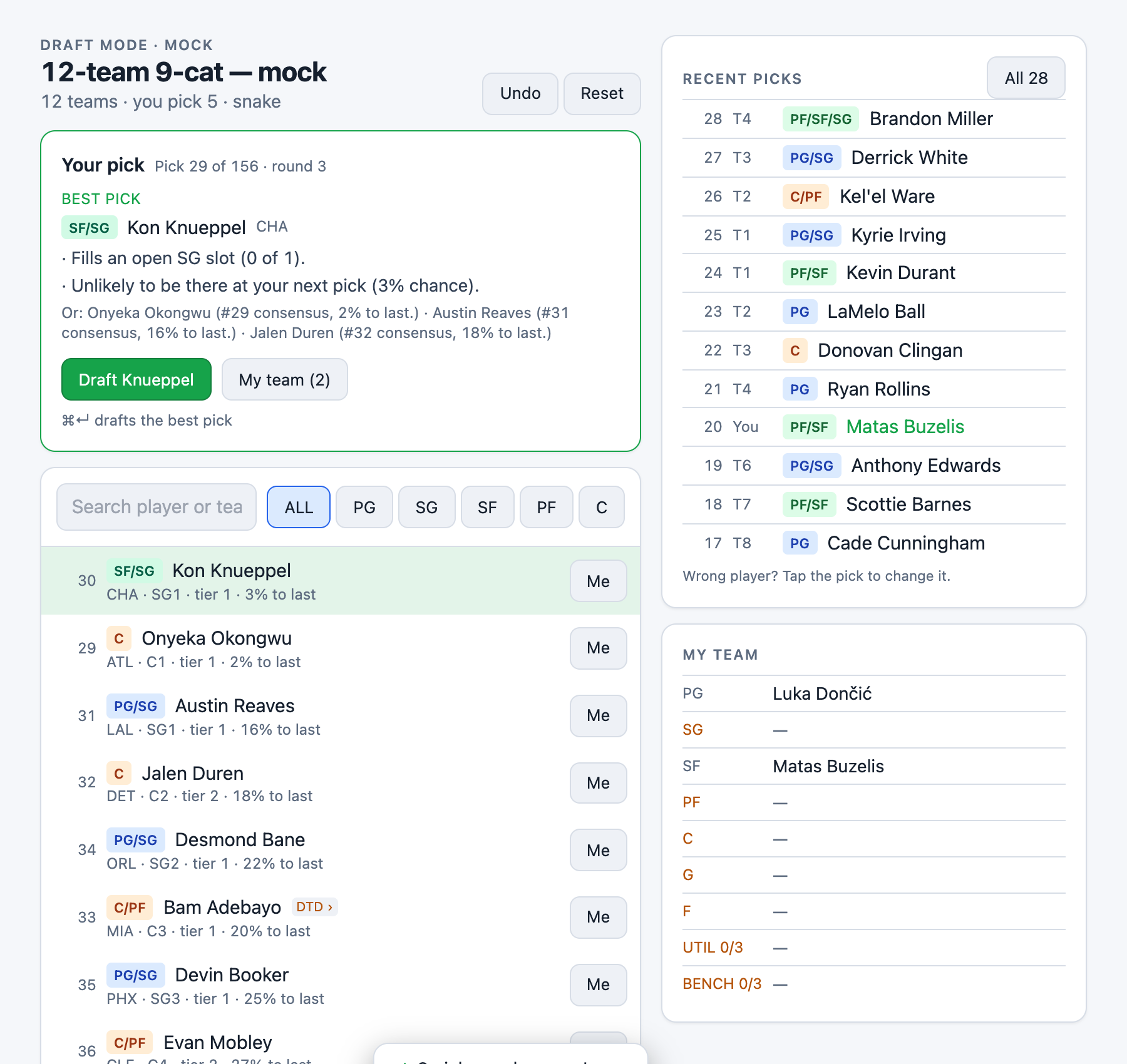
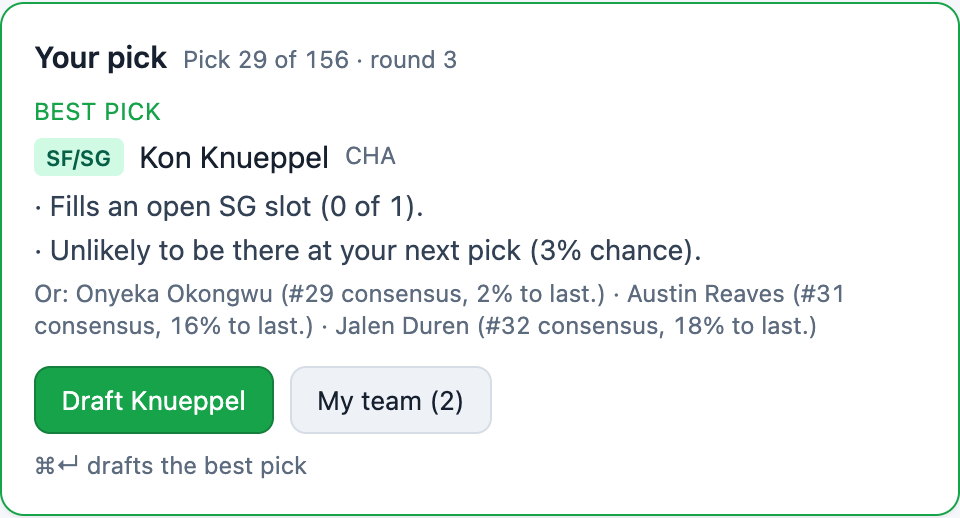
Round 3 of a 12-team 9-cat mock, pick 5. Names and picks from a real run of the board.
Seven things the board knows that a cheat sheet doesn't
Every recommendation comes with its reasons.
Fills an open slot, last of the tier, unlikely to last to your next pick, fell past his consensus — read straight off the board, not written by a model. Three alternatives sit under it with the one thing that separates them, so a pick you disagree with is a one-tap change.
The Draft button appears only when you are on the clock. Off-turn it is pure downside.
9-cat, 8-cat, punt, or points — the board reorders.
Every player is a z-score in each of your categories against the pool your league will roster, FG% and FT% weighted by attempts. Drop turnovers and the high-usage guards climb; punt free throws and the board stops charging Giannis for his. A points league scores the same lines with your points-per-stat instead. Tiers break at the real gaps in that number, per position, so the top of the board is not twelve one-player tiers.
Next to each player: the chance he is still there at your next pick, from where the other teams are actually drafting — the number that says when a reach is justified and when you can wait.
Every pick lands on the board as the room makes it.
Shape the board from a connected Sleeper league, choose Live, and the board follows the draft: the order and your slot come from Sleeper, each pick is recorded the moment it is made, and the board tells you when you are on the clock. You draft in Sleeper; the board keeps up and keeps advising.
Yahoo and ESPN rooms are recorded by hand — one tap per pick — and if the room gets ahead of you, tell the board it is your pick and it catches up, leaving the unrecorded picks blank to fill in later.
A PG/SG counts toward both needs, and a candidate is valued by the best slot he can fill. G, F and UTIL rows are real slots, not afterthoughts — C gets no share of them, which is exactly its scarcity.
Need-weighting is soft early and hard late: it never talks you into a third centre at pick one, and when the picks left equal the holes left, filling the hole is the only recommendation.
Out for the season is worth a quarter of his rank; day-to-day is flagged, not discounted; a player with no team is worth nothing. None is ever the recommendation without saying so.
Mock opponents draft from ADP with reaches and fallers, and stop hoarding a position once they have enough of it. A full 12-team, 13-round draft simulates in seconds.
Mock now. Run the real thing on draft night.
- ✓Shape a draft from a league you have connected — its real roster slots and scoring
- ✓Or from a preset: 12-team 9-cat, 10-team points, Sleeper, Yahoo or ESPN roster shapes
- ✓Or type in the teams, your slot, the rounds and the scoring
- ✓Simulate to your turn, pick, undo, reset, run it again from a different slot
- ✓Phone, tablet or laptop; free, with no league connected
Questions
Is draft mode free?
Yes, for everyone, with no trial clock and no league connected. The season pass is for the in-season product: the Monday memo, the checks before tip-off, streams and trades, extra leagues.
Does it follow my Sleeper draft live?
Yes. Shape the board from your connected Sleeper league, choose Live, and every pick lands on the board as the room makes it — yours and theirs. The board polls the draft and tells you when it is your turn. Yahoo and ESPN drafts are recorded by hand, one tap per pick, and the board keeps up.
Where do the rankings come from?
Rotowire's per-game projections and ADP, published through Sleeper, scored by the category model for your league's scoring — the same model that writes the weekly memo. An 8-cat league, a 9-cat league and a points league see three different orders from the same lines.
How does it handle multi-position players?
A PG/SG counts toward both the PG and the SG need, and a candidate is valued by the best slot he could fill. The board never lets a roster end the draft with a slot nobody on it can play: when the picks left equal the holes left, filling becomes the only recommendation.
What about injured players?
A designation on a draft sheet is read against ESPN's NBA injury feed: out for the season is worth a quarter of his rank; day-to-day is flagged and not discounted. Tap any name for the note as written and the expected return.