
The board that started it.
Fantasy Memo was a draft app first. A live board that values every player for your league, draws real tiers, tells you who will still be there at your next pick, flags the bye-week collision before you make it, and says why the pick is the pick. It is still here, on the same research that writes the weekly memo — and it is free.
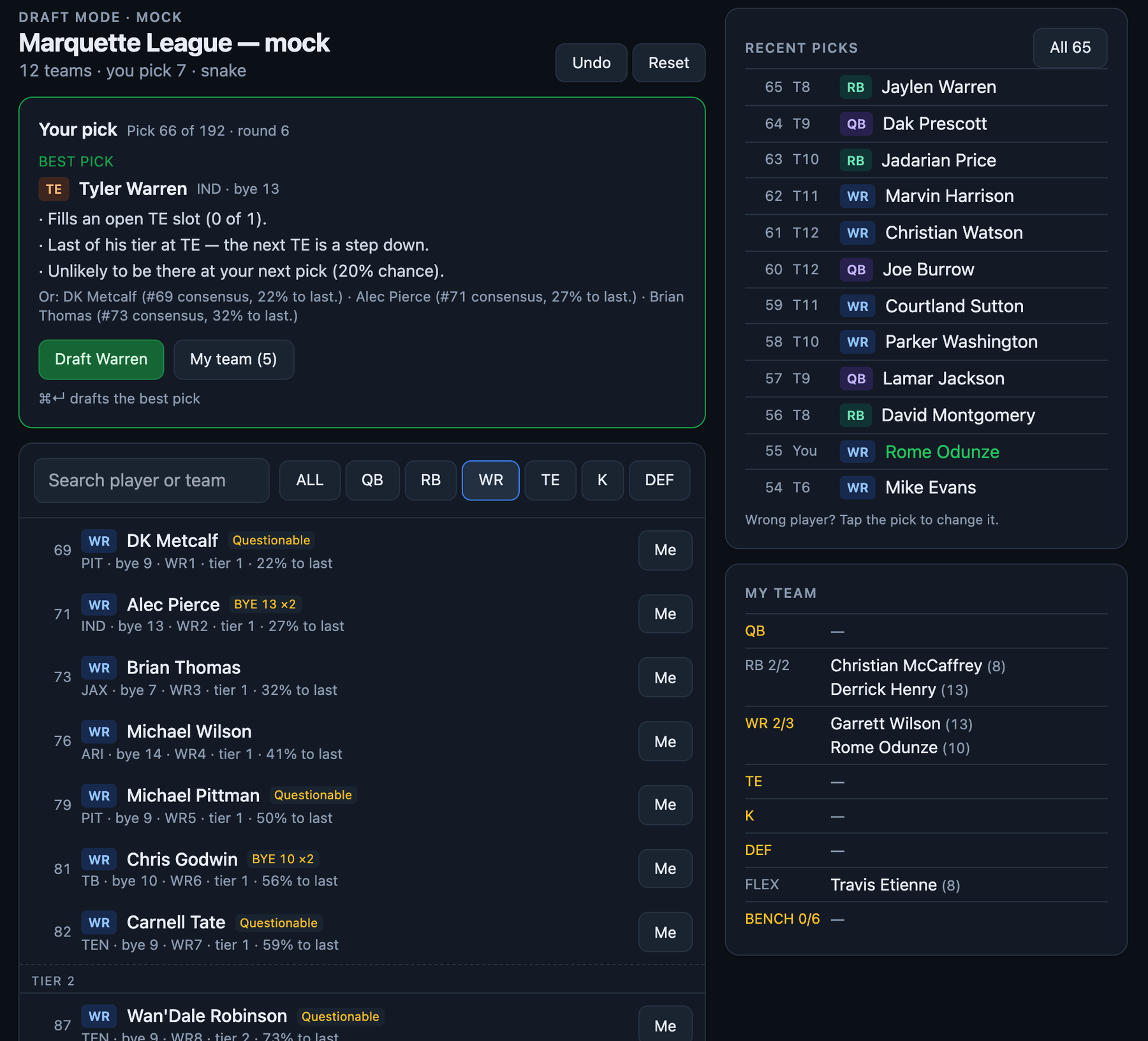
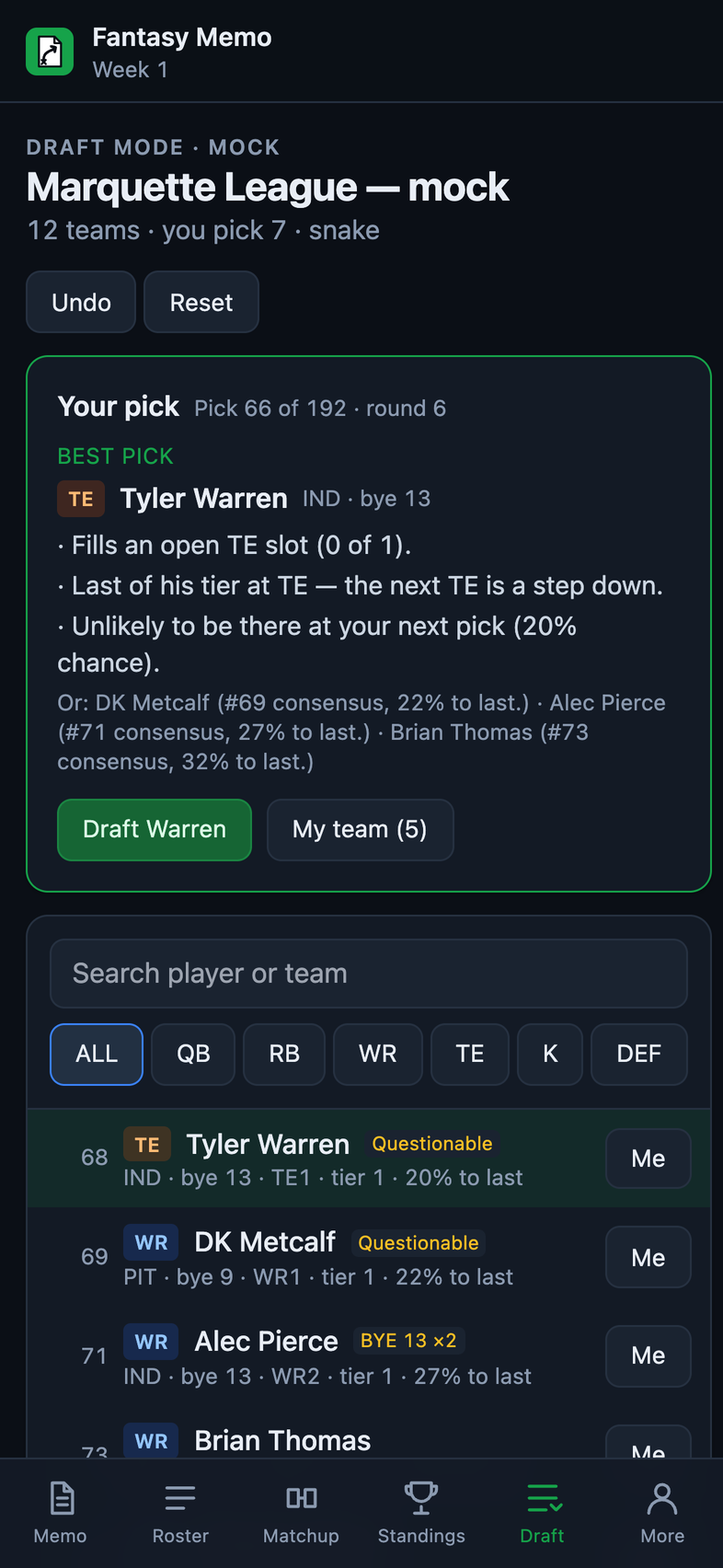
Round 6 of a 12-team PPR mock. Names and picks from a real run of the board.
Seven things the board knows that a cheat sheet doesn't
Every recommendation comes with its reasons.
Open slot, last of the tier, unlikely to last to your next pick, fell past his consensus rank — read straight off the board, not written by a model. Three alternatives sit under it with the one thing that separates them, so a pick you disagree with is a one-tap change.
The Draft button appears only when you are on the clock. Off-turn it is pure downside.
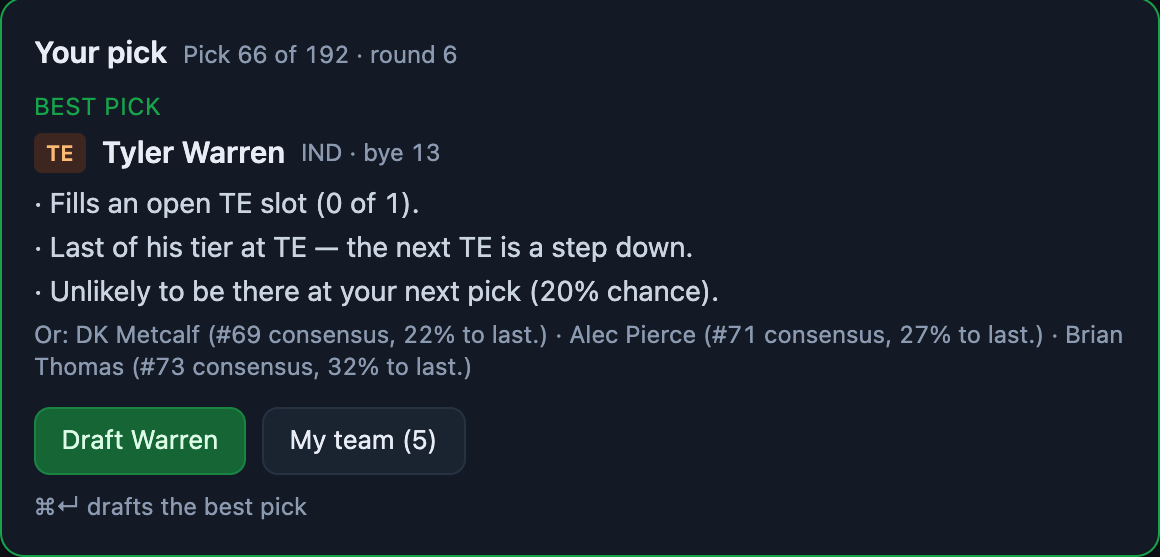
Tap any name. “Questionable” becomes an answer.
A designation on a draft sheet tells you nothing — half of them are “Undisclosed.” Every player's card says what the injury actually is, whether it matters (routine, minor, real, avoid), why, and the one thing that would change the verdict. Below it: his role, the case for, the case against, and the specific question analysts disagree on.
It is researched from current web coverage, not from what a model remembers, and it is re-run automatically the moment his designation changes or fresher news lands. Each card is dated and carries its own confidence — current reporting found, only fragments, or nothing current — because a confident paragraph with nothing behind it is worse than none.
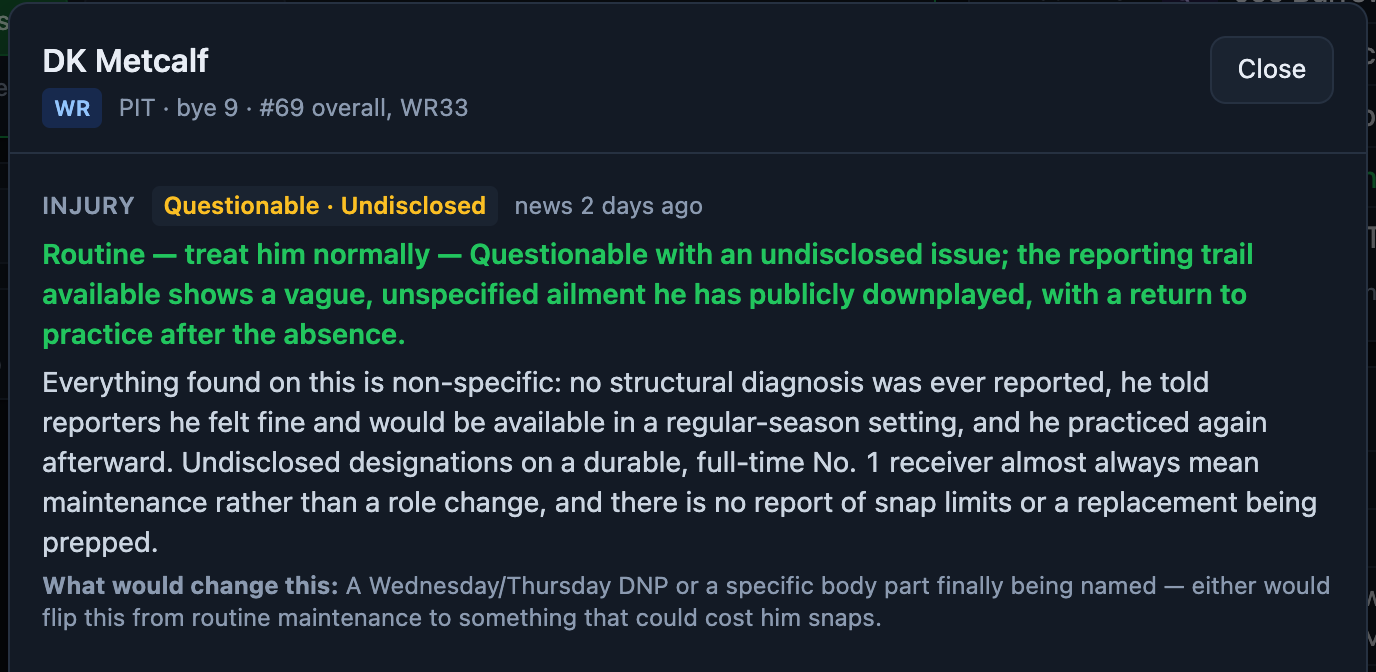
The collision is flagged on the board, not discovered in October.
Every player is checked against the ones you already hold at his position. A second receiver on the same bye is marked with the week. A third that would leave you unable to field the position that week is marked in red, penalised in value, and never recommended — the board will steer you around him without a word.
After the draft, the weekly memo picks the thread up: the Week 7 collision it finds in Week 1 comes with the free agent who covers it and the last week to make the move.

Tier breaks at the real gaps. A percentage on every name.
Tiers break at the largest relative gaps in value, so the top of the board isn't twelve one-player tiers and the tail isn't one blob. Next to each player: the chance he is still there at your next pick, from where the other teams are actually drafting. That is the number that tells you when a reach is justified and when you can wait a round.

Six-point passing touchdowns widen the gap between quarterbacks; the board knows by how much and moves every QB accordingly. PPR, half, standard, TE premium — the value curve follows your league.
Need-weighting is soft early and hard late: it never talks you into a third receiver at pick one and never lets you leave a starting slot empty at pick fourteen.
A player with no NFL team is worth what he can score, which is nothing; one ruled out is worth a fraction of his ranking until he isn't. Neither is ever the recommendation.
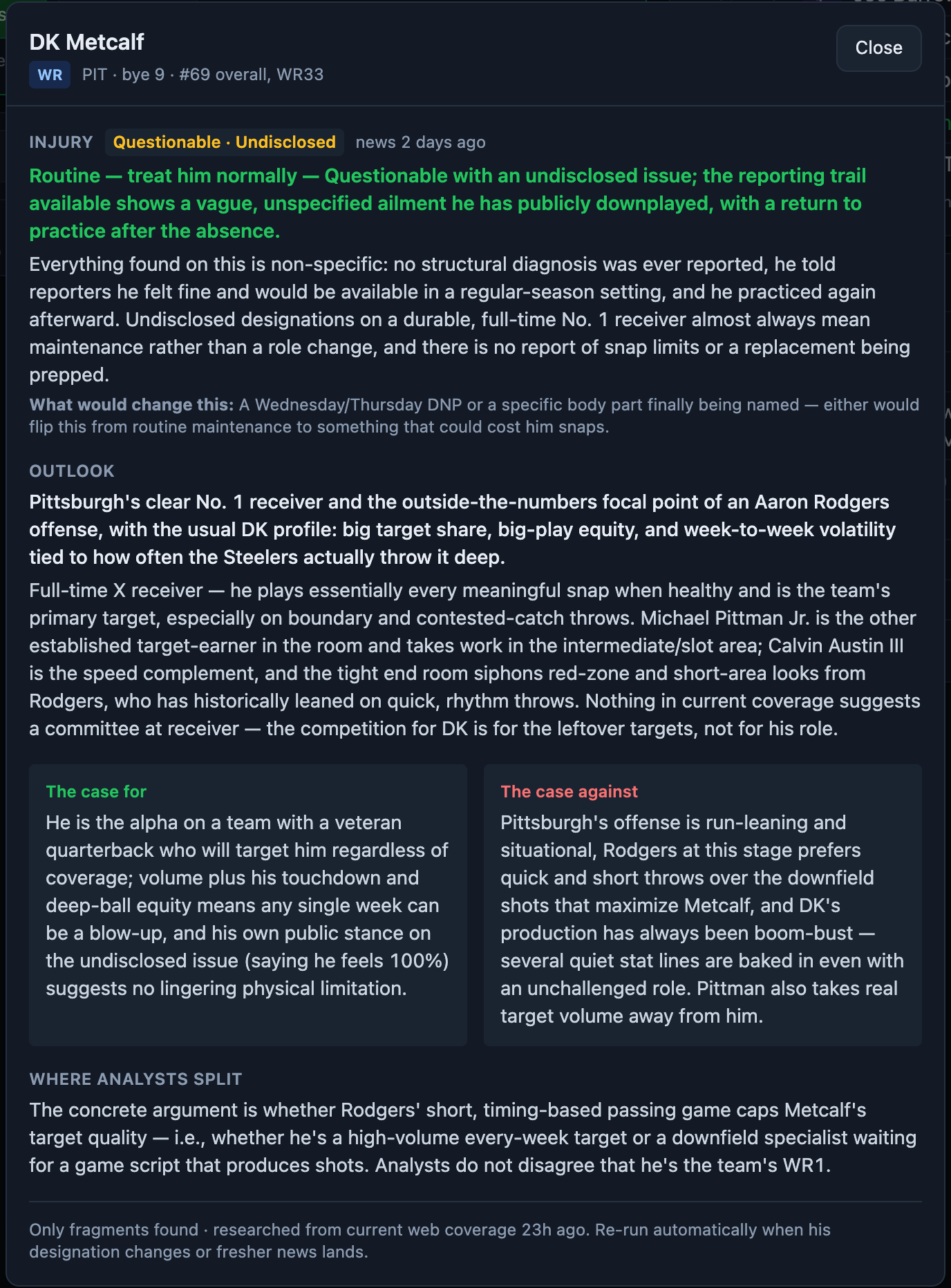
The research a draft guide would charge you for, current as of this week.
The same research pool that writes the weekly memo sits behind the board: every player inside the draftable range has a card, refreshed daily through the season as designations move and news lands. Nothing on it is scored for your league — the card describes the player and the situation; the board does the valuing.
- ✓What the injury is and whether it matters — with what would change the answer
- ✓Role in concrete terms: snaps, targets, who competes for the work
- ✓The strongest case for him and the strongest case against
- ✓The specific question analysts are split on, or “broad agreement” when they are not
- ✓Dated, with the confidence the research itself reported
Built for the moment the room gets ahead of you.
Late rounds, everyone talking, picks flying. You look down and the board still has Team 8 on the clock — but it's your turn. Every draft tool we have used makes you invent the picks you missed to get back to your slot. This one doesn't.
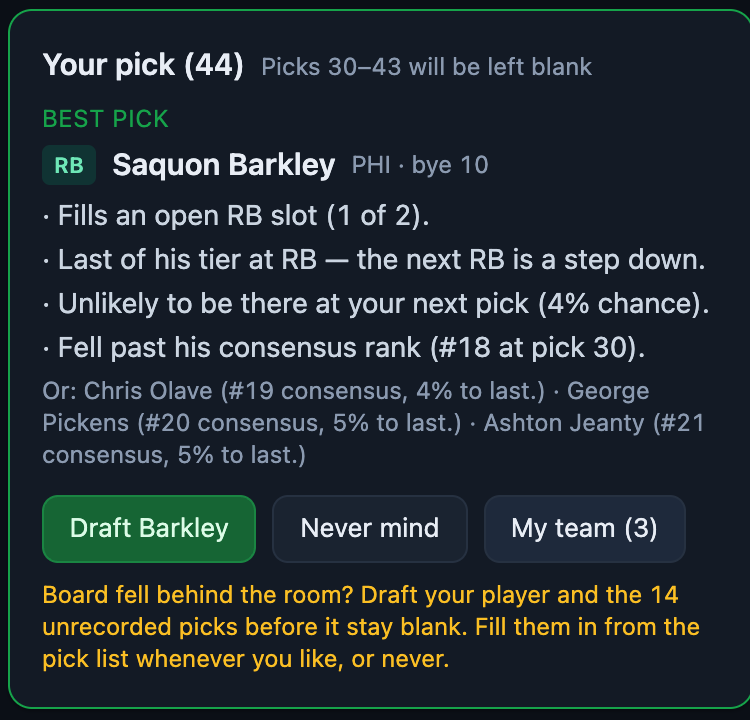
Tap “It's actually my pick” and keep drafting.
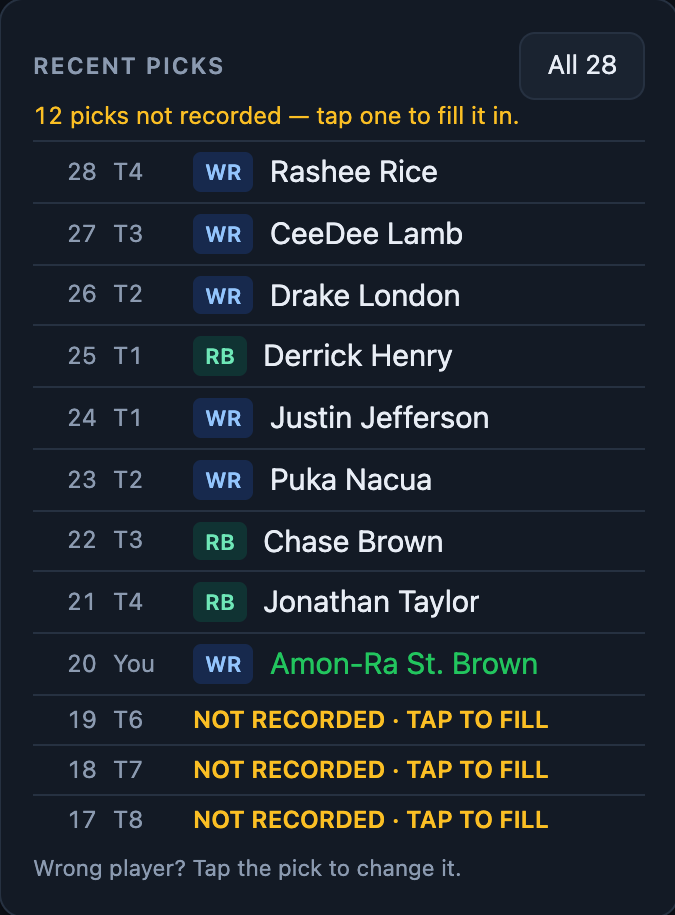
Your pick lands on its real number, the snake continues from the right place, and the picks nobody recorded are left blank on the log. Fill them in during the next lull, or never — the board keeps working either way, and your roster is exactly what you drafted.
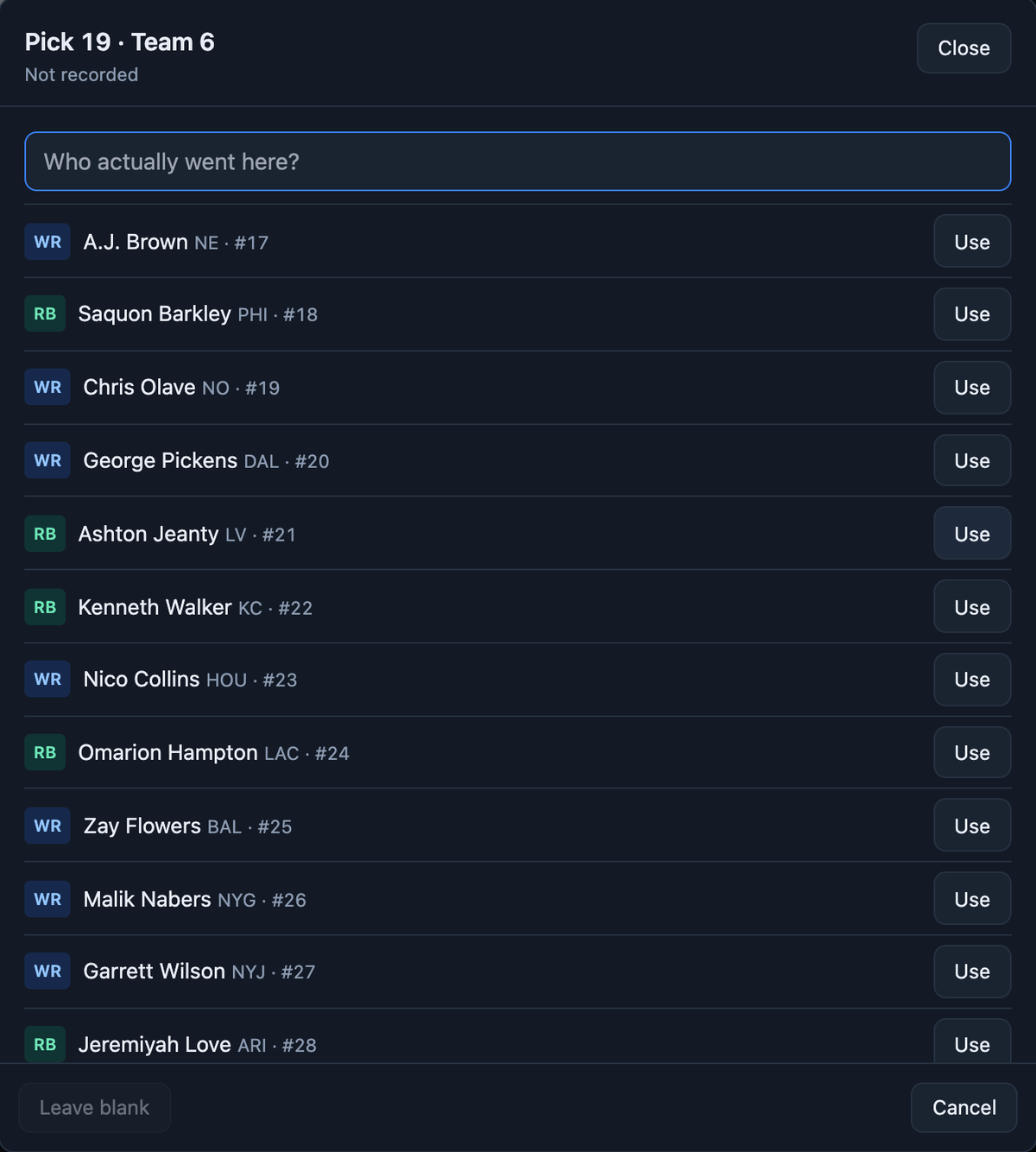
Tapped the wrong player? Tap the pick.
Any pick on the log — yours or theirs, blank or wrong — opens a search of the undrafted board. Change it, or clear it. The pick number never moves, so the clock cannot drift. Undo still takes back the last pick; this reaches all of them.
Mock drafts that behave like real ones.
Opponents draft from consensus with reaches and fallers, and stop hoarding a position when they have enough of it. A mock that only ever sees perfect ADP order gives you a misleading picture of who survives to your pick. Simulate to your turn, make your pick, undo, reset, run it again from a different slot — a full 12-team draft simulates in seconds.
- ✓Shape a draft from a league you have connected — its real roster and scoring
- ✓Or from a preset, or type in the teams, your slot, the rounds and the scoring
- ✓Phone, tablet or laptop; the board is the same on all three
- ✓Free, with no league connected
Questions
Is draft mode free?
Yes, for everyone, with no trial clock and no league connected. The season pass is for the in-season product: the weekly memo, the lineup checks, trades and extra leagues.
Does it sync with my Sleeper, ESPN or Yahoo draft?
Sleeper, yes: shape the board from your connected league, choose Live, and every pick lands on the board as the room makes it. ESPN and Yahoo drafts are recorded by hand — one tap per pick — and the board keeps up. If the room gets ahead of you, tell the board it is your pick and it catches up, leaving the unrecorded picks blank to fill in later.
Where do the rankings come from?
The same research pool that writes the weekly memo: consensus ADP blended with current, web-grounded research on each player, then corrected for your league's scoring and roster.
How current is the injury information?
Each player's card is researched from current web coverage and stamped with when it was written; it is re-run automatically when his designation changes or fresher news arrives, and the daily research job keeps the whole pool inside a day. Every card also reports its own confidence — whether substantive current coverage was found, only fragments, or nothing.
What does it do about bye weeks?
Every player on the board is checked against the players you already have at his position. A second RB on the same bye is marked; a third that would leave you unable to field the position that week is marked in red and never recommended.