
Arithmetic decides. The AI argues. You get the final say.
Most “AI fantasy” tools ask a model to guess. Fantasy Memo does the opposite: everything that can be computed is computed, in the open, and the model is used for the three things it is genuinely good at — reading this week's reporting, writing a clear argument, and arguing back when you disagree.
Every slot has an Analysis. The FLEX is the close one this week.
A coin flip. McLaurin ranks higher but draws Philadelphia's secondary; Tuten's matchup is neutral and he carries a Questionable tag.
This week's value: research rank on a curve, moved at most ±15% by the opponent. It compares players; it never predicts points.
FLEX recomputed: Tuten 52.2 over McLaurin 49.0. The exchange stays on the slot; withdraw it and the number goes back.
Not a screenshot: one slot's analysis, played through. The numbers are a real Week 1 league's; the exchange is illustrative. Hover to pause, tap a bar to jump.
Five steps, in this order — because the order is the point
Every roster, not just yours.
Connect Sleeper with your username; Yahoo, MyFantasyLeague and Fleaflicker with a league id; ESPN from a desktop browser; anything else by pasting or screenshotting your roster (step-by-step guide). Fantasy Memo reads settings and scoring, every team's roster and set lineup, the weekly scoreboard and the standings. It never writes anything back.
Reading the whole league is what makes the rest possible: a trade has to improve their lineup too, and a matchup is only a matchup if it knows who you play. It also reads what kind of league it is — keeper, dynasty, chopped, best ball — and advises accordingly.
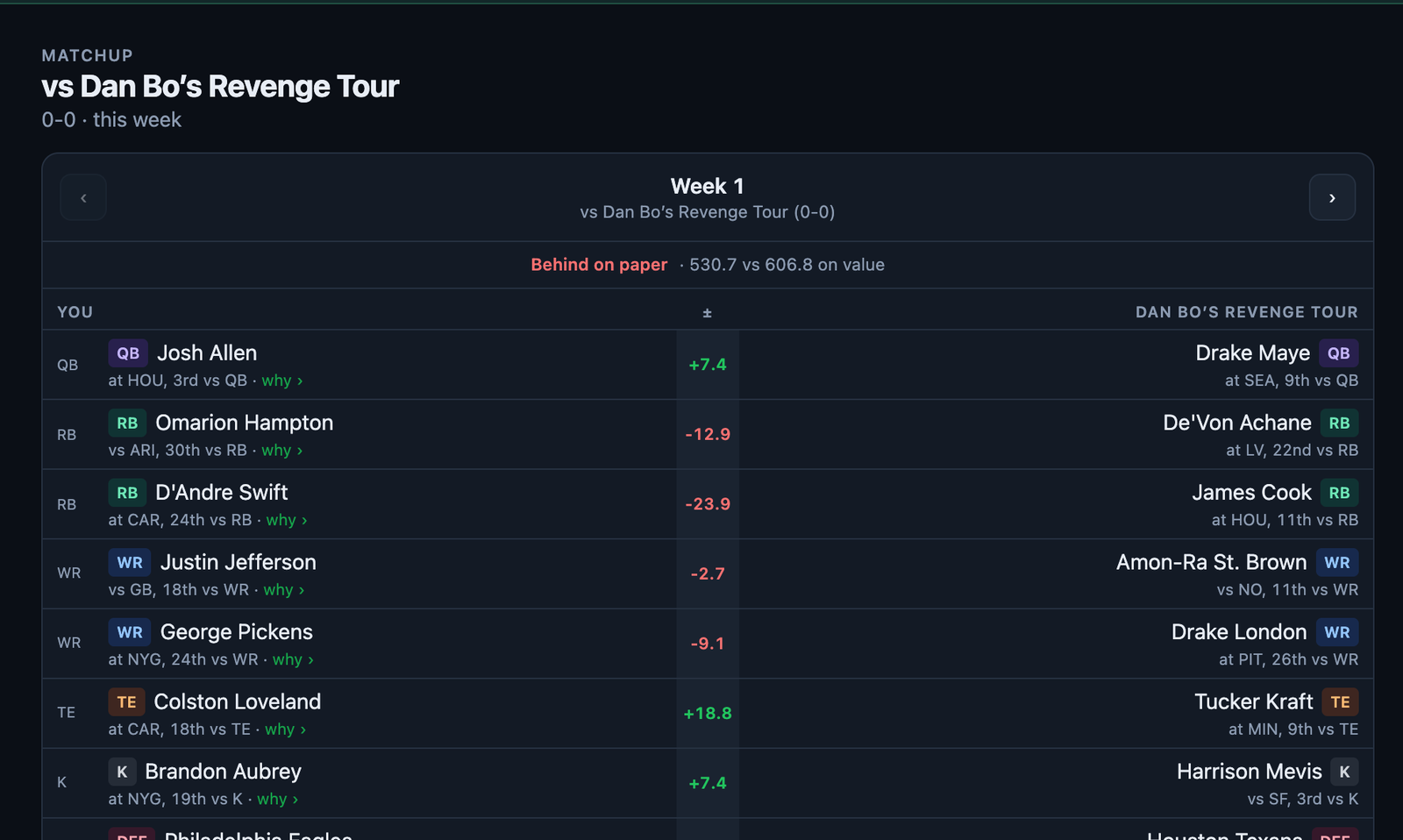
The injury report, as written, hours old. Then a read of it.
Every two hours through the week, and hourly on Sunday morning, the wire is read: the actual body part, the expected return date, and the report as written — “left Thursday's practice with a cramp, Schefter reports.” A model reads each new report and says whether it matters, with what would change the answer.
Behind that, a written outlook per player — role, the case for, the case against, where analysts split — researched from current coverage and dated, with the confidence the research itself reported. Shared across every user, so the cost never rides on you.
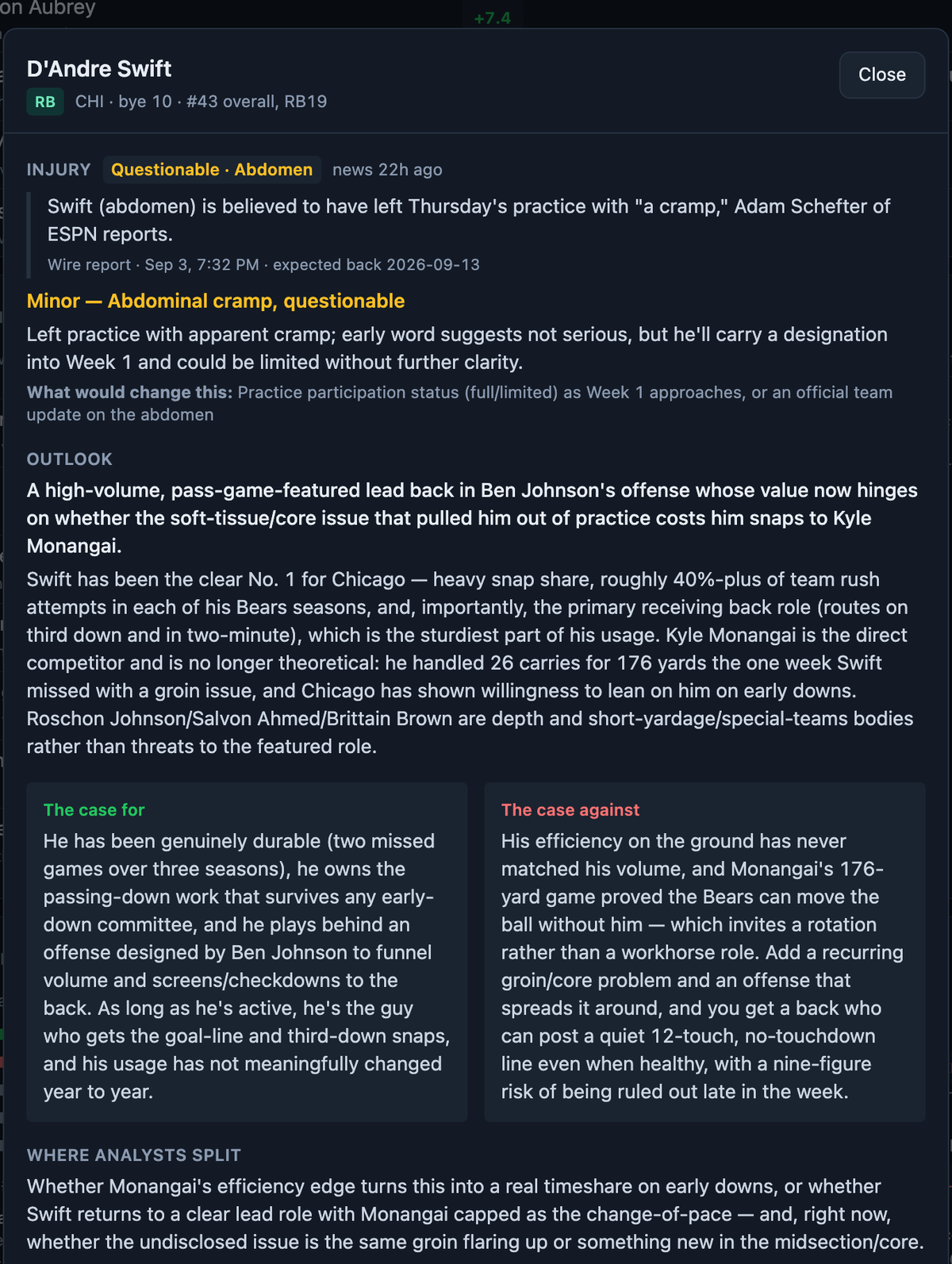
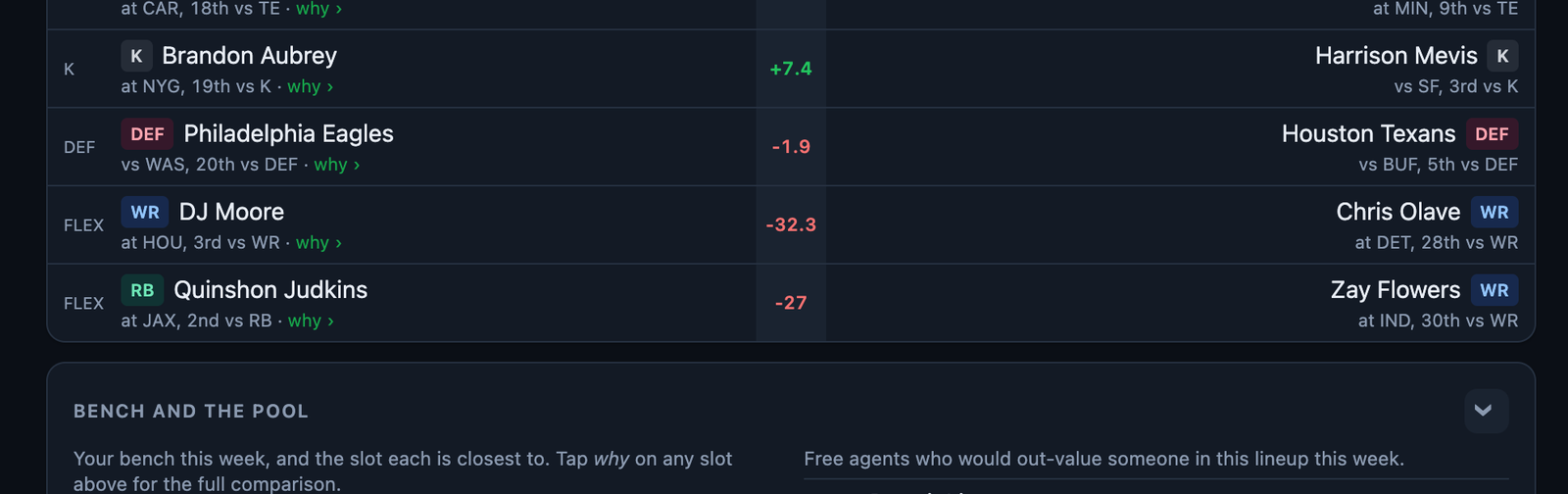
A number you can take apart.
Each player's research rank becomes a base value on a curve; the opponent moves it by at most ±15% depending on how that defense treats the position; a bye or a ruled-out player is worth zero this week. The lineup is the best arrangement of those numbers — and every slot has an Analysis that shows the starter beside every bench player who fits, the gap, and any free agent who would beat him.
- ✓Start/sit: what you actually set on the platform, diffed against the best lineup
- ✓The matchup: both lineups slot by slot with the gap on every row, and a verdict — favoured, even (within 3%) or behind on paper — that always shows the total gap and its percentage
- ✓Byes ahead: the same arithmetic run over every remaining week, with the free agent who covers each hole and the last week to act
- ✓Trades: every pairing of your roster against every other, keeping only offers that improve both lineups
- ✓The league: power rank against record, who is strong and thin where, who to call
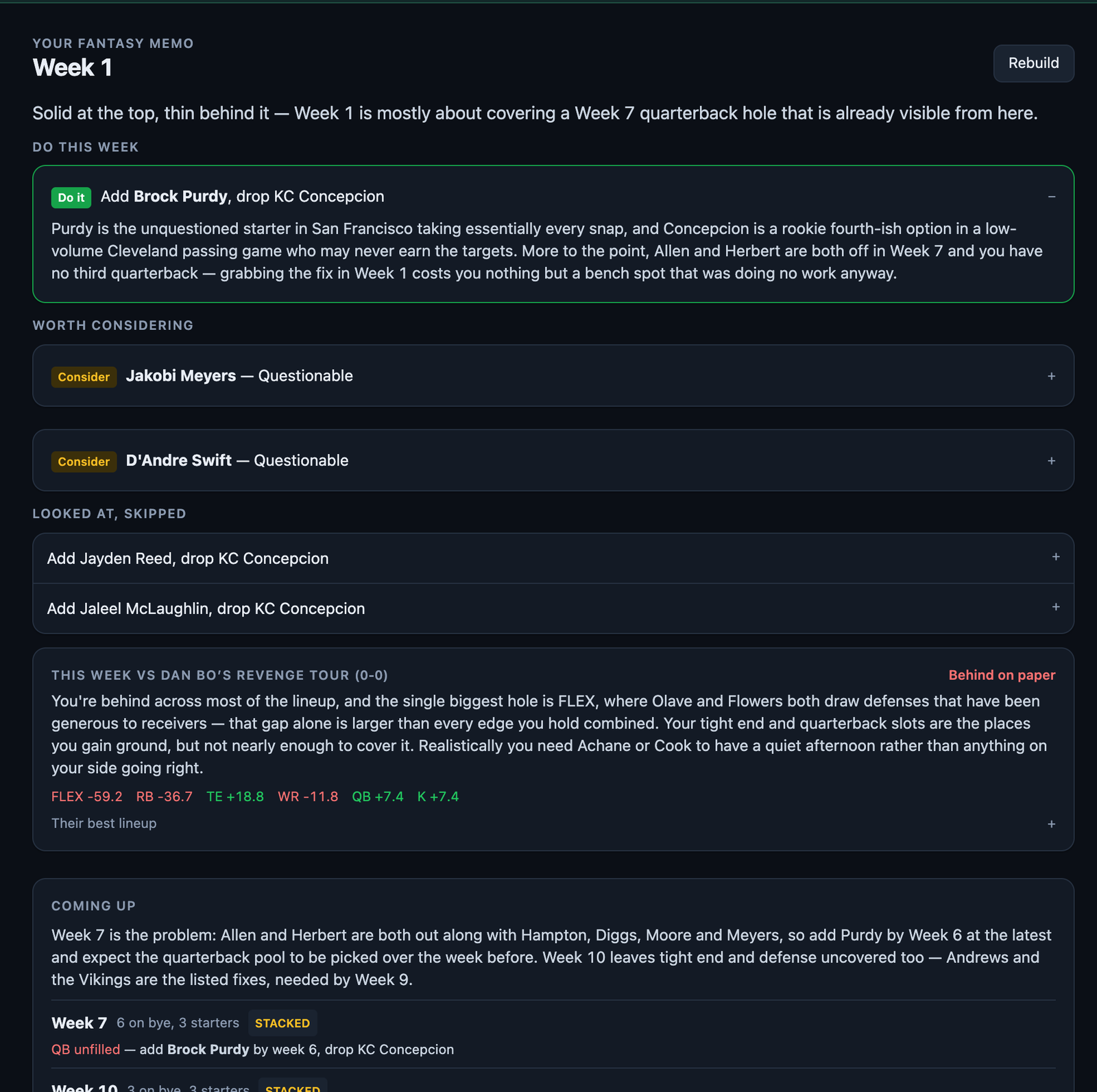
Argued, not ranked. “Skip” is an answer.
Tuesday morning the model gets the computed moves and the research and is told: argue each one, say skip when it is not worth it, and never invent a move. That is why a memo reads like advice from someone who watched the tape — and why it cannot tell you to start a player on bye. The arithmetic ran first.
Do this week. Worth considering. Looked at, skipped — with the reason. Your matchup. The weeks ahead. The league. And the message to send when there is a trade to make.
A consultant, not a verdict. You ask, we answer, you decide.
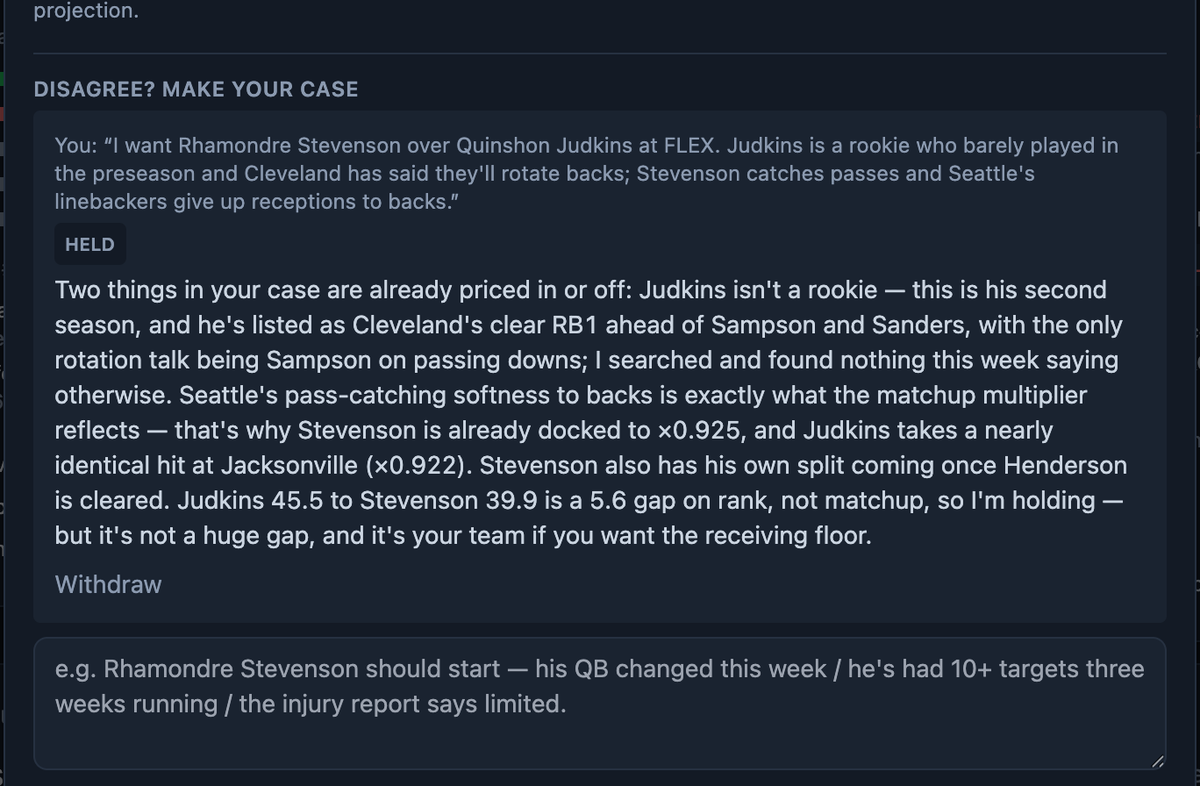
Disagree with a slot? Make your case in a sentence. The consultant sees the same numbers you do and the research behind them, checks a factual claim against current reporting when it needs to, and answers in a few sentences: held, partly conceded or agreed.
It will tell you when your argument is already priced in. It will tell you when you are wrong on a fact — and it will tell you when you are right, in which case it leans the player for the week (never more than 15%) and recomputes the lineup on the spot. The exchange stays on the card; withdraw it whenever you like.
The exchange on the right is real: the manager called Judkins a rookie. He isn't, and the consultant checked.
Three moments a week. You never have to remember to look.
Written after waivers clear: the lineup, the adds and drops, the trade, the byes ahead, the league. In your inbox and in the app.
No model, no cost: the arithmetic re-runs against inactives, injuries and byes as the wire updates. You get an email only if something needs a hand.
Roster, Matchup and Standings, with the week arrows to look ahead or back, the Analysis on every slot, the card on every name, and the consultant when you disagree.
The same engine runs the draft board it began as.
Consensus value corrected for your league's scoring, need-weighting that tightens as the draft goes, tiers at the real gaps, the chance each player lasts to your next pick, bye collisions flagged before you draft into them, and a reason on every recommendation. Free for everyone.
How draft mode works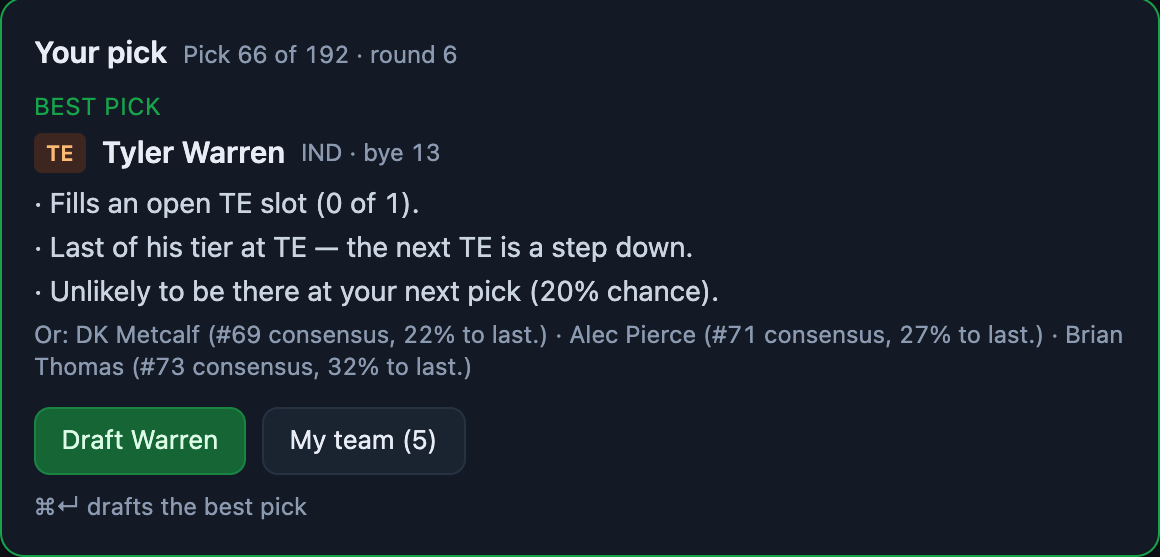
Questions
Does the AI pick my lineup?
No. Arithmetic picks it — season value from research rank, zeroed for a bye or a ruled-out player, moved at most ±15% by the opponent. The model never chooses a player; it reads current reporting, writes the memo, and answers you when you disagree.
What happens if I disagree with a call?
Tap Analysis on the slot and make your case. The consultant answers with the same numbers you can see — it holds when the case is already priced in, checks a factual claim against current reporting, and concedes when you have something the numbers do not. A concession leans that player for the week, capped at 15%, and the lineup is recomputed on the spot. You can withdraw it any time.
How current is the injury information?
The wire is read every two hours through the week and hourly on Sunday morning: the actual body part, the expected return date and the written report, dated. A model reads each new report within hours and says whether it matters. Nothing on a card is a model remembering; it is a report you can read yourself, and a verdict written against it.
Does it ever touch my league?
Never. Every connection is read-only — Sleeper, ESPN and Yahoo. It cannot set a lineup, make a claim or send a trade. It tells you what to do; you do it.
What if the AI is down on a Tuesday?
You still get the computed moves: the lineup, the swaps, the waiver adds, the byes ahead, the trades. The memo degrades to the arithmetic; it never disappears.